by Anastasia Barone
What fears and anxieties have come to gather around “gender,” and how has gender been transformed into a phantasm of contemporary life? What characterizes contemporary anti-gender movements, and what forms of exclusion and rights-stripping do they enable? What forms of equality, freedom, and new alliances can be imagined beyond the politics of fear?
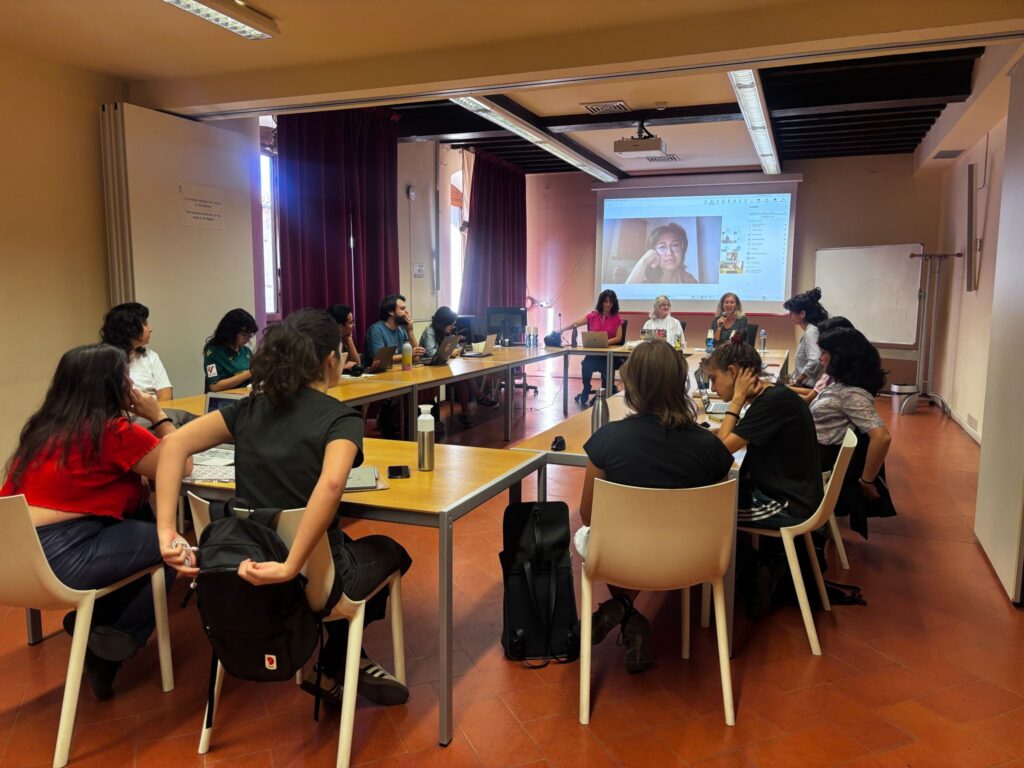
These are some of the central questions raised by Judith Butler in Who’s Afraid of Gender? (2024, Farrar Straus & Giroux), the book discussed during the Reading Butler in Florence seminars organized by the Gender and Politics Working Group at the Scuola Normale Superiore on the 22 and 29 of September.
Why a reading seminar? The format takes seriously Butler’s invitation to “slow the entire public discussion down”. At a time when debates around gender are shaped by extremely accelerated sense of urgency, by over-simplification and polarization, collective reading offers a different rhythm which is already a form of resistance. Taking time means creating room for complexity and critical reflection, and for asking carefully what kinds of fears, political projects and relations of power are being condensed around the term “gender.”
The first session, focused on the introduction Chapter 6, What about Sex?, and Chapter 7, What Gender Are You? Participated by students, PhD, researchers and professors, the discussion explored the importance of emotions in current anti-gender movements, as well as the relationship between anti-gender politics, autocratization and the stripping of rights, before returning to longstanding feminist debates around sex and gender, nature and culture. The conversation also pointed to a broader question raised by the book: how should we understand the democratic implications of political projects built around fear, exclusion and the restriction of rights? Understanding these questions emerged as a central task for contemporary political science as well as an urgent matter for society at large.
While the first session focused on understanding the roots and nature of anti-gender movements, this is only part of the task. During the second session, the group turned to the question of what kinds of futures can be imagined beyond fear, exclusion, and democratic erosion. As Butler suggests, imagining the future is not simply an abstract intellectual exercise: “Imagining does not take place only in the mind. It requires an object, a medium, a sensuous form of expression.” Imagination, then, also concerns the forms through which possibilities become perceptible and begin to take shape.
Drawing on Chapter 8, Nature/Culture: Toward Co-Construction, Chapter 9, Racial and Colonial Legacies of Gender Dimorphism, and the conclusion, The Fear of Destruction, the Struggle to Imagine, the conversation explored the idea of co-construction and the relationship between gender and coloniality. It also turned to feminist passions and futures, asking what is needed not only to counter anti-gender movements, but also to experiment with alternative democratic ways of life. This meant looking beyond resistance understood only as opposition, and toward the everyday practices, relations, and forms of resistance that already exist and from which different futures might begin to emerge.
The reading seminars are also conceived as preparation for a broader conversation that will continue in October, when Judith Butler will join the Scuola Normale Superiore as a Ciampi Visiting Scholar.